






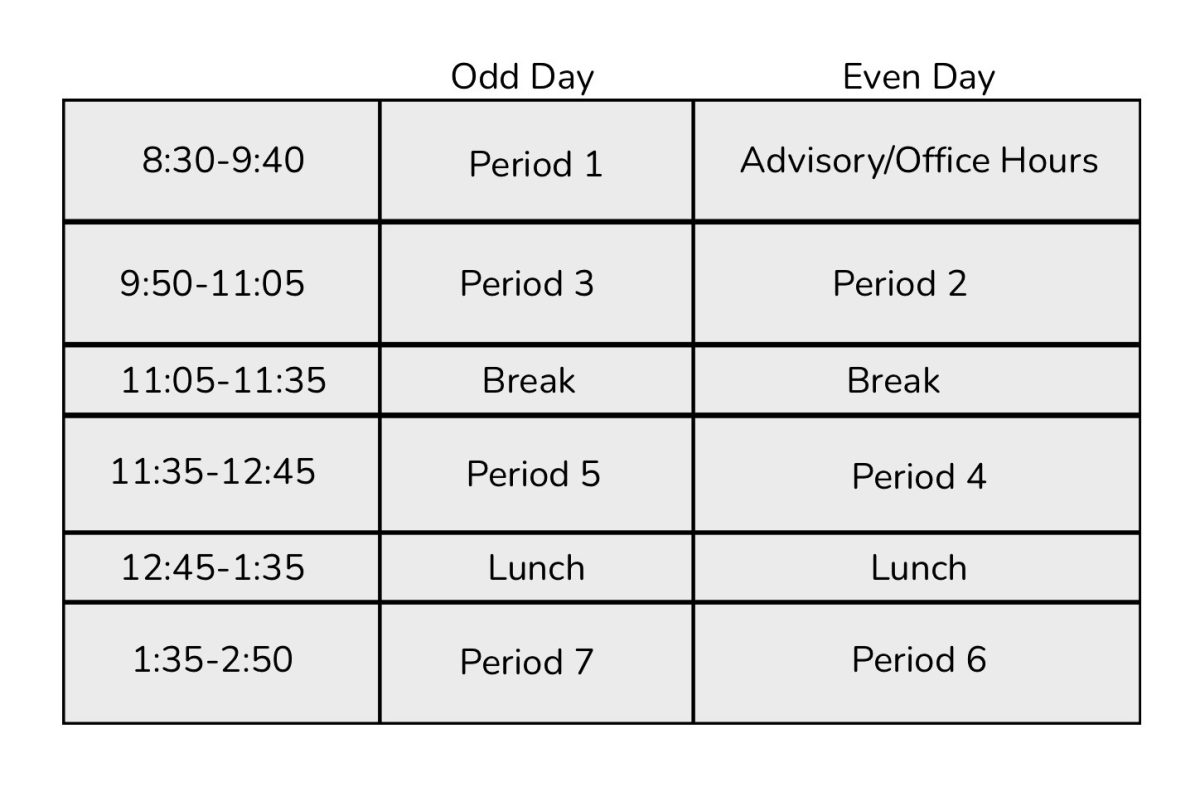

 Every Paideia student has experienced the anxiety around class sign-ups and advisory reports. But does it have to be this way? What if we redesigned Paideia’s schedule to allow students more freedom and more support simultaneously?
I propose adding a seventh period to Paideia’s schedule: freshmen would take a foundational humanities course covering writing, research, ethics, philosophy and geography; sophomores would take an introductory physics course; and upperclassmen would gain more flexibility when choosing themes and seminar courses to take. “I would love to take classes like sociology or a second elective, but there are only so many things I can do because of the schedule,” says Lucy Baines ’27. Eva Gartland ’27 adds, “It would be really helpful to have more free time during senior year to work on college applications—that could be an elective.”
Although adding an extra period means more material for students to learn, limiting homework and out-of-class essays would make the workload manageable. Covering basic writing, research, geography and ethics skills separately also removes content from English 9, World History and U.S. History while replacing the short term ethics course entirely, meaning decreased classroom and homework time per subject wouldn’t necessarily lessen student learning. Additionally, the algebraic elements in introductory physics courses would supplement Algebra II and precalculus curricula, benefiting students who may appreciate extra practice or a different approach to math. “I took Martin’s exploring physics short term class as freshman because it sounded interesting,” says Everett Johnson ’28, “Getting exposed to ideas like forces really helped me before taking physics as an upperclassman.”
Another major structural change I would suggest is moving Short Term A to the weeks between Thanksgiving and holiday break. Truncating Long Term 1 (by moving finals week to mid-November) would serve to decrease early burnout, keep students engaged throughout October and avoid the sickness and holiday/travel stress that comes with December.
Consequently, extending Long Term 2 allows for fairer grading—as averages taken from 4-5 tests represent a student’s performance more accurately than averages taken from 2-3 tests—and helps students find a rhythm before getting thrown straight into Paideia’s many spring events.
Under this new schedule, Paideia students would have more freedom to explore the wonderful courses available to us. In a world attempting to reduce secondary education to pre-professional pipelines or a mere vehicle to receive college admissions decisions, fostering a genuine love of learning, curiosity and risk-taking is paramount to Paideia’s mission.