











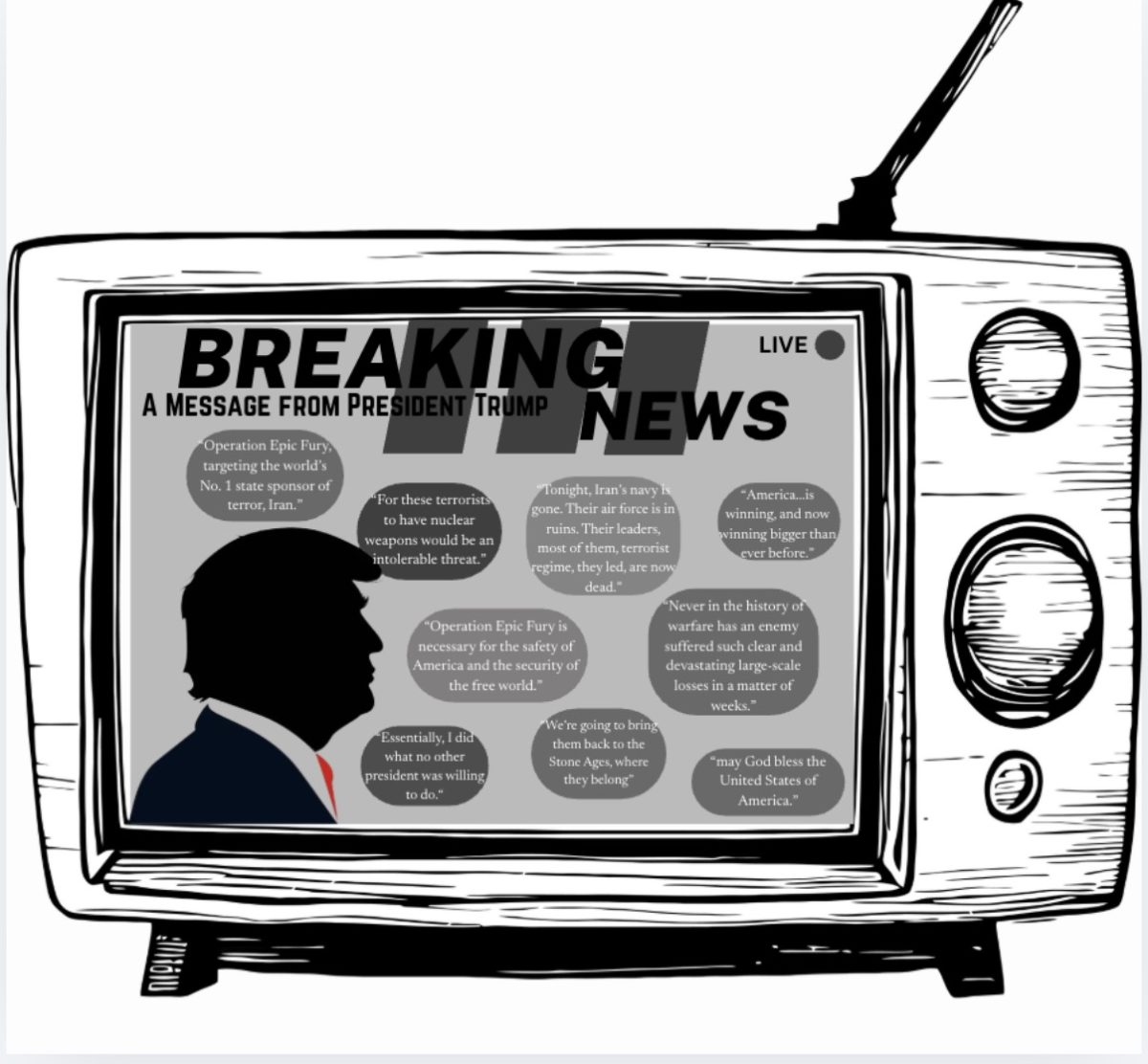
On Feb. 28, President Donald Trump issued an order for the United States military to bomb multiple Iranian cities to eliminate nuclear threats. The major strikes included attacks on Tehran, Fordow and Natanzand Isfahan, but according to BBC News, there were at least “191 attacks across Iran.”
As part of the initial strikes, there was a targeting mistake that hit a girls’ primary school in Minab, Iran, killing around 168 people, including 110 children. Initially, Trump denied the accusations, stating, “We think it was done by Iran, because they are very inaccurate with their munitions,” but an investigation from the Department of Defense determined that these airstrikes were in fact a “targeting error” by the U.S.
This conflict ties back to June 13, 2025, when Israel initiated an attack on Iranian military and nuclear bases in Iran. “The attack was supported by the U.S. and killed the Iranian supreme leader, Ayatollah Ali Khamenei, who had led the country since 1989,” says BBC News.
When Khamenei presided over Iran, he took control of multiple important branches of the government. According to the Washington Institute, “his rule had a direct impact on much of the region, and under his leadership the Islamic Republic of Iran became one of the world’s biggest state sponsors of terrorism.” He protected people in power, disregarding terrorism, opinions of his people and student uprisings. When the airstrikes ended in his death, “there was really a remarkable exhibition of joy in the streets,” says Abbas Milani, the Hamid and Christina Moghadam Director of Iranian Studies at Stanford University.
Although Khamenei’s control over the Iranian people is over, Trump and his administration publicly called for them to change the government, which was taken over by Mojtaba Khamenei. President Trump stated, during a press conference in Florida that, “We go forward more determined than ever to achieve ultimate victory that will end this long-running danger once and for all.”